Patellofemoral Pain Syndrome: An Evidence-Based Treatment Summary
Patellofemoral pain (PFP) is among the most frequently encountered presentations in musculoskeletal practice, affecting individuals across the lifespan from adolescence to older adulthood.
Patellofemoral pain (PFP) is among the most frequently encountered presentations in musculoskeletal practice, affecting individuals across the lifespan from adolescence to older adulthood and carrying a considerable personal and societal burden. It is also a condition in which passive modalities are commonly employed, despite growing evidence base that favours active management. This summary consolidates the recommendations of current consensus statements and clinical practice guidelines, distinguishing interventions that are supported, those that remain uncertain, and those that are not recommended to support the efficient, evidence-based use of limited treatment time.
What is Patellofemoral Pain?
PFP presents as pain around or behind the patella that is provoked by activities loading the patellofemoral joint in flexion, such as squatting, stair descent and ascent, running, prolonged sitting and jumping. There is no single confirmatory test, and the label is reached by recognising the characteristic load-related anterior knee pain pattern while excluding other sources such as patellar tendinopathy, intra-articular pathology and referred pain.
Contemporary consensus has moved away from older terms like "anterior knee pain syndrome" or "chondromalacia" toward "patellofemoral pain" as the umbrella clinical term, reflecting that the condition is multifactorial rather than tied to a single structural lesion.
Contributing factors are usually grouped as local, proximal and distal.
- Local factors include quadriceps weakness or altered timing and patellar tracking.
- Proximal factors centre on the hip with weakness of the abductors and external rotators, and altered hip kinematics that allow dynamic knee valgus during loading.
- Distal factors include foot posture and excessive or poorly controlled pronation.
- Extrinsic drivers include a rapid increase in running volume, a change of surface or footwear, or a spike in jumping and squatting load.
Importantly, many of these factors are associations rather than proven causes, and some may be as much a consequence of the pain as a cause of it.
How is Patellofemoral Pain Diagnosed?
Diagnosis is clinical and rests on the history and a small number of tests rather than imaging. The hallmark is retropatellar or peripatellar pain reproduced by at least one activity that loads the joint in flexion:
- A squat is the single most useful provocation, reproducing symptoms in the large majority of people with PFP.
- Stair descent, a single-leg squat or step-down, and prolonged sitting (the so-called "theatre sign") are also informative.
The examination is then as much about exclusion as confirmation. Differentiate PFP from:
- Patellar tendinopathy: Pain localises to the inferior pole of the patella and tracks with energy-storage load such as jumping and landing.
- Intra-articular pathology: Meniscal or chondral lesions may give effusion, locking or true mechanical symptoms, none of which are typical of PFP.
- Adolescent traction conditions: Consider Osgood-Schlatter (tibial tuberosity) and Sinding-Larsen-Johansson (inferior patellar pole) in skeletally immature patients.
- Referred pain: Always screen the hip and lumbar spine, as both can present as anterior knee pain.
Routine imaging is not indicated for a straightforward presentation and does not change management. Reserve it for atypical features, suspected alternative pathology, or a failure to respond as expected.
Alongside the diagnosis, assess the modifiable contributors, because these are what your programme will target:
- Hip and quadriceps strength
- Movement quality on a step-down
- Foot posture
- Recent training load
Exercise Therapy For Patellofemoral Pain Syndrome
Across the consensus statements and guidelines, exercise has the largest evidence base for improving pain and function in the short, medium and long term, and it is the clear first-line treatment. The most important practical refinement is that:
- Combined hip-focused and knee-focused exercise outperforms knee-focused exercise alone.
- Adding hip-targeted strengthening (for the abductors, external rotators and extensors) to traditional quadriceps work produces better outcomes, particularly for pain and function.
While structuring a programme, take care of these things:
- Rather than concentrating solely on the quadriceps and the patellofemoral joint itself, build a programme that loads the whole kinetic chain, including the hip and knee together.
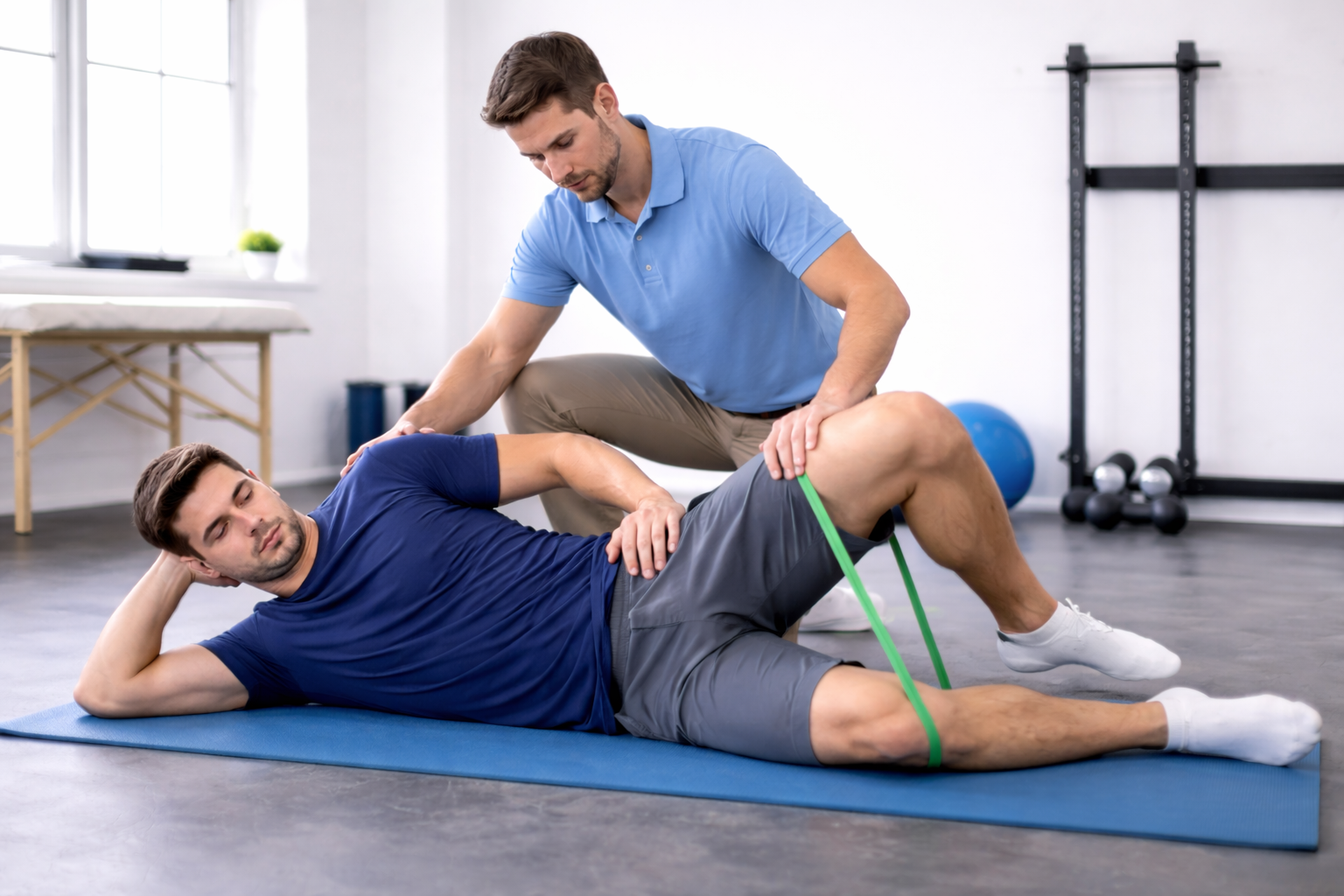
- You may combine hip work such as side-lying or banded abduction, hip external rotation and extension work, progressing toward loaded, weight-bearing patterns with knee-focused quadriceps strengthening, using closed-chain exercises such as squats and step-ups through a pain-acceptable range, and adding open-chain quadriceps work as tolerance allows.
- Progress it like any other strengthening intervention, with an adequate dose, adherence and progression over weeks to months.
- Meaningful change typically needs several weeks of consistent loading, with gains continuing over three months and beyond.
- Tell your patients that a modest, acceptable level of pain during and after exercise that settles by the next day is generally fine and does not signal harm.
- Programmes that combine exercise therapy with other elements (for example, exercise plus education, or exercise plus foot orthoses) are supported, reflecting that PFP is multifactorial and rarely responds to a single isolated input.
- Prefabricated foot orthoses are recommended to reduce pain, particularly in the shorter term, and are a reasonable adjunct to exercise in appropriately selected patients.
- Education and active self-management underpin every guideline-concordant programme, helping set expectations and support adherence to the exercise that does the heavy lifting.
Which Treatment Is Uncertain?
While commonly used, there is insufficient evidence to prove the efficacy of the following practices while treating patellofemoral pain syndrome:
- Patellar taping and bracing
- Acupuncture and dry needling
- Manual soft-tissue techniques
- Blood flow restriction training
- Gait retraining
You may use them as adjuncts within a primarily exercise-based programme, and be honest with patients about the uncertainty rather than presenting them as established treatments.
What Is Not Recommended While Treating Patellofemoral Pain Syndrome?
Patellofemoral, knee or lumbar mobilisations used in isolation are not recommended, and electrophysical agents are not recommended for treating PFP. These are interventions to actively avoid, especially when they crowd out time and patient engagement that would be better spent on progressive loading.
A Practical Treatment Framework
Putting the evidence together gives a clear hierarchy.
- Start with education and a clear, realistic explanation of the condition.
- Build the programme around progressive, combined hip-and-knee exercise therapy as the core intervention, dosed and progressed properly over a meaningful timeframe.
- Add foot orthoses where indicated, particularly when shorter-term pain relief would help the patient engage with exercise.
- Reserve the uncertain interventions (taping, manual therapy and the rest) as optional, individualised adjuncts rather than headline treatments.
- Steer away from isolated passive mobilisation and electrophysical agents entirely.
- Manage training load alongside strengthening by identifying recent spikes in activity, modifying the load, and rebuilding it gradually rather than resting completely.
- Relative rest to settle an irritable knee is reasonable in the short term, but the destination is a progressively loaded, capable joint, not avoidance.
- Tailor the emphasis to the patient by prioritising load management for a runner who spiked their mileage, and hip strengthening for a patient with weak hips and a collapsing knee.
KineticFlow For Patellofemoral Pain Management
KineticFlow helps you:
- Keep the programme evidence-aligned: Structured records make it easy to build around combined hip-and-knee exercise and to document the adjuncts you have chosen and why.
- Track outcomes against baseline: Pain and function scores are stored over time, so you can see whether an adequately dosed programme is actually moving the needle.
- Spot the slow responders early: When progress stalls, baseline prognostic factors and adherence data are right there to revisit before changing course.
- Hold a consistent plan over a long programme: Because PFP rehabilitation runs over weeks to months, the record keeps each review building on the last.
In a condition where time is best spent on progressive loading, KineticFlow keeps your management focused on what the evidence actually supports.
Try KineticFlow for your next patellofemoral pain assessment!
References:
https://bjsm.bmj.com/content/52/18/1170 https://www.jospt.org/doi/10.2519/jospt.2019.0302 https://www.cochranelibrary.com/cdsr/doi/10.1002/14651858.CD010387.pub2/full
https://bjsm.bmj.com/content/50/14/839 https://bjsm.bmj.com/content/47/4/227
https://doi.org/10.4085/1062-6050-231-15
https://pubmed.ncbi.nlm.nih.gov/29925502/ https://www.aafp.org/afp/2019/0115/p88 https://pubmed.ncbi.nlm.nih.gov/24221245/ https://www.sciencedirect.com/science/article/pii/S155541551500829 https://www.nhsinform.scot/illnesses-and-conditions/muscle-bone-and-joints/leg-and-foot-problems-and-conditions/patellofemoral-pain-syndrome/
https://my.clevelandclinic.org/health/diseases/17914-patellofemoral-pain-syndrome-pfps https://www.hopkinsmedicine.org/health/conditions-and-diseases/patellofemoral-pain-syndrome-runners-knee