Neck Pain: A Clinical Reasoning and Classification Framework
A structured classification framework allows the clinician to reason from a broad presenting complaint toward a defensible working category, and to match the intervention to that category rather than applying a uniform protocol to every patient.

Neck pain is among the most prevalent musculoskeletal complaints in clinical practice, and it ranks highly among global causes of years lived with disability. The majority of presentations are non-specific, in that no single structure can be identified as the definitive source. This does not, however, render assessment arbitrary. A structured classification framework allows the clinician to reason from a broad presenting complaint toward a defensible working category, and to match the intervention to that category rather than applying a uniform protocol to every patient. This article sets out the four-category framework that underpins contemporary practice, the reasoning sequence that supports it, and the points at which further investigation is warranted.
Why Classify Neck Pain Rather Than Treat It Generically?
Treating all neck pain identically disregards the considerable heterogeneity of the presentations grouped under the term. A patient with a stiff, movement-restricted neck, a patient recovering from a whiplash injury, a patient whose headache originates in the upper cervical spine, and a patient with pain radiating into the arm all may share the affected region, but other factors vary. Their natural histories, prognoses, and responses to treatment differ materially.
Classification serves three purposes:
- It directs the examination toward the tests that discriminate between subgroups
- It indicates which interventions the evidence supports for that subgroup
- It establishes a shared vocabulary for communication with referrers and for audit
The framework is impairment-based, meaning patients are grouped according to the dominant pattern of impairment identified on examination rather than a presumed pathoanatomical lesion.
How Is Neck Pain Classified?
Clinical practice guidelines classify neck pain into four impairment-based categories, each linked to the stage of the condition (acute, subacute, or chronic):
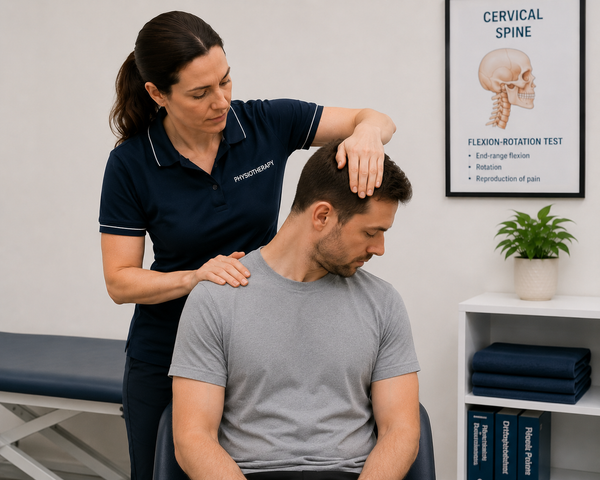
- Neck pain with mobility deficits. The dominant feature is restricted cervical range of movement, typically with segmental hypomobility on manual testing. Active range of motion, the cervical flexion-rotation test, and cervical and thoracic segmental mobility tests are the relevant examination items.
- Neck pain with movement coordination impairments. This category encompasses whiplash-associated disorders. The picture is one of impaired neuromuscular control, reduced neck flexor endurance, and frequently heightened pain sensitivity. The craniocervical flexion test and the neck flexor muscle endurance test are central to the assessment.
- Neck pain with headache. This corresponds to cervicogenic headache, in which head pain is referred from the upper cervical segments. Active range of motion, the cervical flexion-rotation test, and upper cervical segmental mobility testing inform the classification.
- Neck pain with radiating pain. This category reflects cervical radicular pain, in which symptoms extend into the upper limb owing to nerve root involvement. Neurodynamic testing, Spurling’s test, the distraction test, and the Valsalva manoeuvre are the discriminating examination items.
A given patient may display features of more than one category; the task of clinical reasoning is to identify the dominant pattern and to remain alert to change over the episode of care.
How Should the Clinical Reasoning Sequence Proceed?
The reasoning sequence moves in a deliberate order.
- The clinician screens for the appropriateness of conservative management and for any need to refer or consult another provider.
- The history and examination are used to assign the patient to one of the four categories, drawing on the discriminating tests listed above and, where relevant, supplemented by assessment of pressure pain threshold to characterise pain sensitivity.
- The intervention is matched to the category and to the stage of the condition.
- Validated outcome measures are recorded at baseline and re-measured at consistent intervals, so that response can be judged against an objective anchor rather than against recollection.
This sequence is iterative as a patient who fails to respond as expected should prompt re-examination and, if appropriate, reclassification.
When Should Neck Pain Prompt Further Investigation?
Most neck pain is benign and mechanical, but a minority of presentations have features that warrant pausing routine treatment and prompt further assessment or onward referral. These include signs suggestive of cervical myelopathy, such as gait disturbance, hand clumsiness, or upper motor neuron signs; a history of significant trauma raising the possibility of fracture, in which a validated decision rule should guide imaging; constitutional features such as unexplained weight loss, fever, or a history of malignancy; and symptoms suggesting cervical arterial compromise, such as the abrupt onset of unusual headache or neck pain accompanied by neurological features. The presence of such features shifts the clinical priority from impairment-based management to timely diagnosis and appropriate referral.
What Does the Evidence Recommend for Each Category?
The guidelines link each category to a corresponding set of interventions.
- For neck pain with mobility deficits, a multimodal approach combining thoracic and cervical manipulation or mobilisation with mixed exercise for the cervical and scapulothoracic regions is supported.
- For movement coordination impairments, the emphasis falls on education, reassurance, and a progressive, individualised exercise programme addressing coordination, endurance, and strength, often incorporating cognitive and affective elements.
- For neck pain with headache, manual therapy directed at the upper cervical spine, combined with mobility and strengthening exercises, is recommended.
- For radiating pain, a combination of mobilising exercise, manual therapy, and, in selected cases, intermittent traction may be considered.
Across all categories, exercise and active management form the foundation, with passive modalities serving as adjuncts rather than as standalone treatments.
How Should Outcomes Be Monitored?
Classification is only useful if its effect is tracked. A region-specific patient-reported measure, such as the Neck Disability Index, should be paired with a pain score, such as the Numeric Pain Rating Scale, and both should be collected at baseline and at consistent review intervals. A change should be interpreted against the established threshold for meaningful improvement and against measurement error before it is treated as a genuine response. A score that fails to move over several weeks is a prompt to revisit the classification and the plan rather than to persist unchanged. Consistent measurement also supports the defensibility of the record and the communication of progress to the patient and to referrers.
What Is the Prognosis, and How Does Staging Influence It?
The classification framework is layered over the stage of the condition because prognosis and the appropriate emphasis of treatment both shift as time passes.
In the acute stage, the priorities are reassurance, the exclusion of serious pathology, the maintenance of movement, and the avoidance of unnecessary investigation. Many acute, non-specific presentations improve substantially within weeks.
In the subacute stage, attention turns to restoring function and addressing the impairments that characterise the patient’s category, with a graded increase in activity. In the chronic stage, where symptoms persist beyond around three months, a broader and more sustained approach is warranted, attending not only to physical impairment but also to the cognitive and affective factors that influence persistent pain. Prognosis is generally more favourable for mobility-deficit presentations than for those dominated by movement coordination impairment following whiplash, where heightened pain sensitivity and psychological factors may prolong recovery.
Communicating a realistic timeframe at the outset is itself part of management, since unrealistic expectations contribute to disengagement from an otherwise effective programme. The clinician should frame recovery as a trajectory to be monitored rather than as a guaranteed endpoint, and should adjust the plan when the measured response diverges from what was anticipated.
KineticFlow for Neck Pain Classification
KineticFlow helps you:
- Assign the correct category: The discriminating examination findings for each of the four subgroups are recorded together, so the classification is explicit and the matched intervention is clear.
- Track outcomes against baseline: Neck Disability Index and pain scores are stored at each visit, demonstrating whether the chosen approach is producing meaningful change.
- Surface red flags early: Documented screening prompts ensure that features warranting further investigation are not overlooked in a busy clinic.
- Support reclassification: Because findings are tracked over the episode, a patient who fails to respond can be reassessed and recategorised on the basis of the record rather than from memory.
Try KineticFlow for your next patient assessment!
References
https://www.jospt.org/doi/10.2519/jospt.2017.0302
https://my.clevelandclinic.org/health/symptoms/21179-neck-pain
https://www.mayoclinic.org/diseases-conditions/neck-pain/symptoms-causes/syc-20375581