Knee Osteoarthritis: Adapting the GLA:D Protocol for Everyday Clinical Use
GLA:D is a structured, physiotherapist-led programme of patient education plus supervised neuromuscular exercise, designed to translate the evidence into routine clinical care.
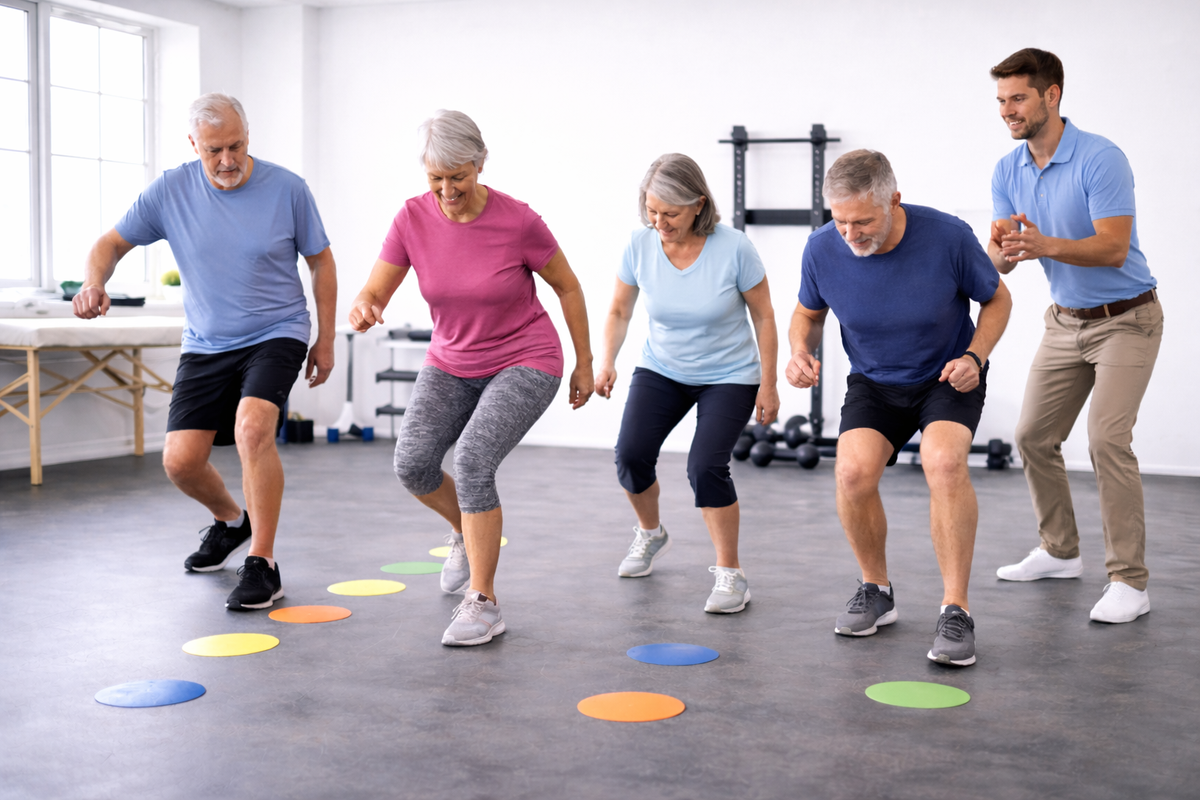
Exercise and education are first-line treatment for knee osteoarthritis (OA) in every major guideline, yet the gap between that recommendation and what patients actually receive remains wide. Good Life with osteoArthritis in Denmark (GLA:D) was built precisely to close that gap. It is a structured, physiotherapist-led programme of patient education plus supervised neuromuscular exercise, designed to translate the evidence into routine clinical care. Registry data across multiple countries show meaningful improvements in pain, function and quality of life, with reduced analgesic use, that are maintained at twelve months. You may not always be delivering certified GLA:D in a formal group, but its underlying structure offers a reliable template you can adapt to everyday practice. This post sets out how to do that without losing what makes it work.
Why GLA:D Works: Two Non-Negotiable Ingredients
GLA:D is deliberately simple, and its effectiveness rests on two components you should preserve in any adaptation. The first is structured education that reframes OA and equips the patient to self-manage. The second is supervised neuromuscular exercise, not generic strengthening, but exercise focused on the quality of movement control, performed in positions that reflect daily life and progressed individually.
The formal programme delivers a small number of education sessions (typically two to three) alongside twelve supervised neuromuscular exercise sessions, usually twice weekly over roughly six weeks.
Exercise reliably reduces pain and improves physical function in knee OA, and what seems to matter is an adequate dose and supervision rather than any single exercise type. Adapting GLA:D is mostly about protecting dose and quality while flexing delivery to your context.
Component 1: Structured Education That Changes Beliefs
The education element does real therapeutic work, because the beliefs patients hold about OA shape whether they engage with exercise at all. Build your education around a few high-yield messages:
- Exercise is first-line treatment, not a last resort or a substitute for "proper" treatment, and it is safe for an osteoarthritic joint.
- Imaging findings and symptoms correlate poorly. Radiographic changes are common and do not dictate how much pain or disability a person will have, so a scan showing "wear and tear" is not a reason to stop moving or to assume surgery is inevitable.
- Some discomfort during and after exercise is acceptable and expected, provided it settles. Patients who understand this in advance are far less likely to abandon a programme at the first flare.
- Surgery is not the default endpoint. First-line conservative care helps a large proportion of patients, and committing to it is worthwhile in its own right.
Delivering these messages explicitly, early and consistently is what turns an exercise prescription into a behaviour change.
Component 2: Neuromuscular Exercise, Not Generic Strengthening
The distinguishing feature of the GLA:D exercise model is its emphasis on neuromuscular control, which ensures sensorimotor and functional exercises are performed with attention to alignment, quality of movement and proper body position. Exercises are chosen to reflect everyday tasks such as sit-to-stand, step control, balance and gait-related work. These exercises are progressed individually based on the patient's ability to maintain control, not on a fixed timeline. This functional framing is part of why adherence holds up.
When adapting this, prioritise movement quality and individualised progression over generic sets and reps. Progress by advancing control, complexity and load only when the patient can perform the current level well, and regress without drama when control breaks down. Pair this neuromuscular core with general strengthening as appropriate, but do not let it be replaced by a generic gym sheet.
Delivery: Group, Individual, or Blended
The formal programme runs in small supervised groups, which adds peer support and is efficient, but the active ingredients survive translation to other formats. In everyday practice, you might deliver the education one-to-one and the exercise in a small group; run a fully individual version for patients who cannot attend group sessions; or blend supervised sessions with a structured home programme. What should not change is the dose of supervised contact and the quality of exercise supervision early on, because that early coaching is what embeds correct, confident movement.
Managing the Common Barriers
Three barriers derail OA exercise programmes more than any others.
- Pain flares: Pre-empt them by teaching an acceptable-pain framework and a simple plan to modify rather than stop.
- Beliefs about joint damage: Address the imaging-versus-symptoms point directly, repeatedly if needed.
- Expectations about surgery: Frame conservative care as the genuine first-line treatment it is, with its own evidence, rather than as a holding pattern before an operation.
Comorbidities and lower baseline fitness are common in this population, so scale entry-level exercise accordingly and progress patiently.
Tracking Outcomes the GLA:D Way
A major strength of GLA:D is its consistent outcome set, and adopting the same measures lets you benchmark your own results and demonstrate change to patients. Track a pain score, objective physical function (the 30-second chair-stand test and a timed walk test are simple and repeatable), a self-reported function or quality-of-life measure such as the KOOS, and physical activity levels. Measuring at baseline and again after the programme, ideally at longer follow-up, turns a series of sessions into a trajectory you can see and act on.
A Note on Fidelity and Certification
GLA:D itself is a certified programme with required training, and delivering official GLA:D requires that certification. Adapting its principles in routine care is legitimate and evidence-aligned. Ensure you are applying the evidence-based components (structured education and supervised neuromuscular exercise) rather than delivering the trademarked programme.
Prognosis and Expectation Setting
Set realistic, encouraging expectations. Most patients can expect meaningful improvements in pain and function with an adequately dosed education-and-exercise programme, and these gains are commonly maintained over the following year. OA is manageable, movement is part of the treatment rather than a threat to the joint, and progress is measured over weeks and months. Plan for fluctuation, equip the patient with a long-term self-management routine, and frame the goal as durable independence rather than ongoing reliance on hands-on care.
KineticFlow For Knee Osteoarthritis Management
KineticFlow helps you:
- Keep the core ingredients together: Education delivered, exercise prescribed, and progression decisions stay in one structured record, so an adapted programme does not lose its shape.
- Use a consistent outcome set: Pain, chair-stand, walk-test, KOOS, and activity scores are tracked over time, allowing you to benchmark results and show patients their trajectory.
- Catch the non-responders early: When progress stalls, documented adherence and baseline beliefs are right there to revisit before changing the plan.
- Support long-term self-management: The home programme and flare plan stay linked to the patient across the long arc of an OA journey.
In a condition managed over years rather than weeks, KineticFlow turns the GLA:D model into a trackable, repeatable part of everyday practice.
Try KineticFlow for your next knee osteoarthritis assessment!
References:
https://bmcmusculoskeletdisord.biomedcentral.com/articles/10.1186/s12891-017-1439-y https://www.cochranelibrary.com/cdsr/doi/10.1002/14651858.CD004376.pub3/full https://pubmed.ncbi.nlm.nih.gov/24574223/ https://pubmed.ncbi.nlm.nih.gov/31278997/ https://pubmed.ncbi.nlm.nih.gov/34903537/ https://www.nice.org.uk/guidance/ng226 https://www.sciencedirect.com/science/article/pii/S2468781224000559