Cervical Radiculopathy: Assessment And The Wainner Test Cluster
Since no single clinical test reliably confirms the diagnosis of cervical radiculopathy in isolation, contemporary practice relies on a validated cluster of tests to raise or lower the probability of nerve root involvement.
Cervical radiculopathy is a condition of neurological dysfunction arising from compression or irritation of a nerve root in the cervical spine. It commonly presents with pain and frequently with numbness or weakness, radiating from the neck into the shoulder, arm, or hand. Because no single clinical test reliably confirms the diagnosis in isolation, contemporary practice relies on a validated cluster of tests to raise or lower the probability of nerve root involvement. This article describes the presentation of cervical radiculopathy, the application and interpretation of the Wainner test cluster, the differential considerations, and the circumstances in which imaging or onward referral becomes appropriate.
What Is Cervical Radiculopathy?
Cervical radiculopathy, often described in lay terms as a “pinched nerve”, occurs when a cervical nerve root is compressed or inflamed where it branches from the spinal cord. In middle-aged and older adults, the most common cause is degenerative change: as the intervertebral discs lose height and water content, the vertebrae settle closer together, and the body forms bone spurs that may narrow the foramen through which the nerve root exits. In younger adults, the more frequent cause is a herniated disc, often associated with a specific episode of bending, lifting, or twisting. The resulting symptoms follow the distribution of the affected root, typically affecting one side of the body, and may include sharp or burning pain, sensory disturbance, and motor weakness in the corresponding myotome. Reassuringly, most cases respond well to conservative management and do not require surgery.
How Is Cervical Radiculopathy Diagnosed?
Electrodiagnostic studies remain the reference standard for confirming nerve root involvement, but they are not always available or practical in a clinical setting. To support bedside diagnosis, a clinical prediction rule comprising four tests is widely used. The four components are:
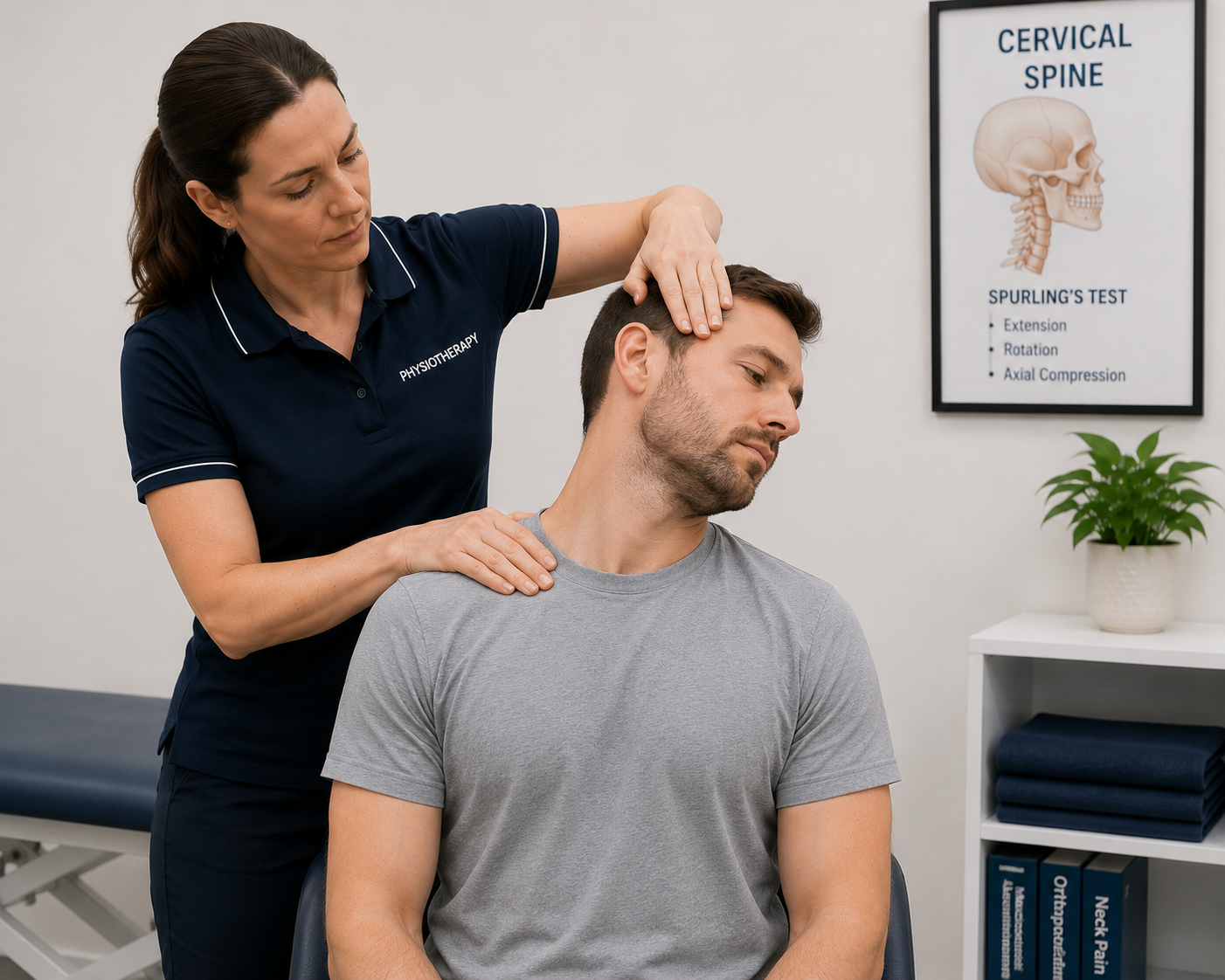
- Spurling’s test: The neck is extended, laterally flexed, and rotated toward the symptomatic side while gentle compression is applied. The test is positive when the patient’s familiar arm symptoms are reproduced.
- Cervical distraction test: With the patient supine, a gentle longitudinal traction force is applied to the head. The test is positive when symptoms are relieved.
- Upper limb tension test (median nerve bias): A sequence of shoulder, elbow, wrist, and finger positioning places the median nerve under tension. The test is positive on reproduction of symptoms, a side-to-side difference in elbow extension, or symptom modulation with contralateral and ipsilateral neck side-flexion.
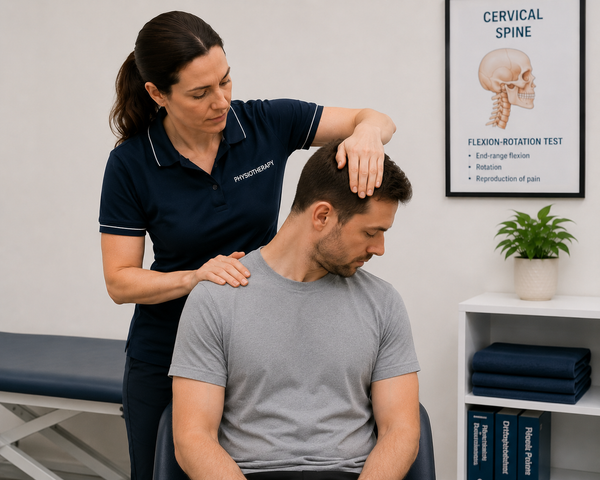
- Ipsilateral cervical rotation of less than 60 degrees: Active rotation toward the symptomatic side is measured and considered positive when restricted below 60 degrees.
The diagnostic value lies in the combination rather than in any single result. When three of the four tests are positive, the cluster carries high specificity, reported at around 94 per cent, with a positive likelihood ratio of approximately 6; when all four are positive, the likelihood ratio rises substantially further. The cluster's sensitivity is relatively low, meaning that a negative cluster does not exclude radiculopathy as confidently as a positive cluster confirms it. The cluster, therefore, functions primarily as a rule-in tool.
How to Distinguish Cervical Radiculopathy From Other Causes of Arm Pain?
Arm pain has numerous origins, and the clinician must reason carefully before attributing it to a cervical nerve root. Other causes of arm pain may include:
- Peripheral nerve entrapment (carpal tunnel or cubital tunnel syndrome) can reproduce numbness, tingling, and weakness in the arm, but the symptoms follow the distribution of a peripheral nerve distal to the point of compression, not a dermatomal or myotomal pattern traceable to a single root. The site of provocation is peripheral (the wrist or elbow) rather than the neck.
- Shoulder pathology can refer pain down the arm, but the referral is non-neurological. There is no sensory loss, no reflex change, and no myotomal weakness, and symptoms are reproduced by shoulder movement and load rather than by neck movement or nerve-root provocation.
A thorough examination therefore screens the shoulder and the peripheral nerves alongside the cervical spine, and checks whether the symptom distribution genuinely corresponds to the suspected root level rather than merely resembling it. Further, degenerative change on imaging does not, by itself, establish the diagnosis, because such change is common in people without symptoms. Imaging confirms the diagnosis only when the clinical picture already points to a specific root and the imaging findings correspond to it.
When Should Cervical Radiculopathy Prompt Imaging or Referral?
Conservative management is appropriate for most patients, but certain features warrant escalation.
- Signs of cervical myelopathy, such as gait disturbance, hand clumsiness, or upper motor neuron signs, indicate spinal cord involvement and require prompt medical referral.
- Progressive or profound motor weakness, rather than sensory symptoms alone, is a further indication for timely investigation.
- Symptoms that fail to improve with a reasonable course of conservative care, or that worsen, justify imaging and specialist opinion.
- Constitutional features suggesting infection or malignancy, and any suggestion of bilateral or rapidly evolving neurological deficit, also fall outside routine conservative management and should be acted upon without delay.
What Does Conservative Management Involve?
For the patient with confirmed or probable cervical radiculopathy and no features requiring escalation, conservative management forms the mainstay. Since most cases follow a favourable natural history and settle over weeks to a few months, a defined trial of conservative care, for usually six to eight weeks, is appropriate before the diagnosis or management plan is reconsidered.
- Manual physical therapy, neurodynamic mobilisation, and exercise directed at the cervical and scapulothoracic regions are the core interventions; intermittent mechanical traction may be added in selected patients, though its supporting evidence is limited and inconsistent.
- The aim of neurodynamic mobilisation is to restore the nerve's capacity to glide and tolerate load without provoking a flare; it is therefore dosed conservatively in an irritable presentation and progressed as symptoms settle.
- Deep cervical flexor training and scapular strengthening address the postural and muscular factors that contribute to ongoing nerve-root irritation.
- Pharmacological adjuncts support engagement with rehabilitation: a short course of NSAIDs for the inflammatory component, and, where neuropathic features predominate, agents such as gabapentin, pregabalin, or amitriptyline.
- Patient education regarding the generally favourable natural history is valuable, and advice on modifying provocative postures and activities reduces day-to-day symptom aggravation.
As with neck pain more broadly, passive treatment serves to facilitate active rehabilitation rather than to substitute for it, and progress should be reviewed at regular intervals.
Escalation, for specialist opinion, imaging, or consideration of injection or surgery, is warranted where there is progressive or severe motor deficit, signs of myelopathy, or intractable pain unresponsive to conservative care.
What Is the Natural History and Prognosis?
The natural history of cervical radiculopathy is generally favourable.
- A substantial proportion of patients improve with conservative management over weeks to months, and the symptoms in many cases resolve without surgical intervention. This favourable trajectory is an important message to convey at the first consultation, because it shapes the patient’s expectations and supports adherence to an active programme during a period in which symptoms may fluctuate.
- Recurrence is possible, particularly where degenerative change is the underlying contributor, and patients benefit from understanding which postures and activities tend to provoke their symptoms.
- The clinician should distinguish between the radiating pain, which often settles, and any motor deficit, which requires closer monitoring, since persistent or progressive weakness carries different implications from pain alone.
- Where a patient remains symptomatic despite an appropriate course of conservative care, or where the deficit progresses, the threshold for imaging and specialist referral should be lowered.
- Setting an honest timeframe, monitoring the neurological examination at each review, and re-evaluating when progress stalls together constitute a defensible approach that neither over-treats a self-limiting condition nor overlooks the minority of cases requiring escalation.
KineticFlow for Cervical Radiculopathy Assessment
KineticFlow helps you:
- Record the test cluster systematically: Each of the four Wainner tests is documented, so the number of positive findings and the resulting diagnostic confidence are explicit in the record.
- Track the neurological examination: Reflexes, myotomes, and dermatomes are stored across visits, making any progression of deficit immediately visible.
- Flag features requiring escalation: Documented prompts for myelopathic signs and progressive weakness support timely referral.
- Monitor recovery objectively: Neck Disability Index and pain scores are tracked throughout the episode to demonstrate whether conservative management is producing meaningful change.
Try KineticFlow for your next patient assessment!
References
https://my.clevelandclinic.org/health/diseases/22639-cervical-radiculopathy-pinched-nerve
https://orthoinfo.aaos.org/en/diseases--conditions/cervical-radiculopathy-pinched-nerve/
https://pmc.ncbi.nlm.nih.gov/articles/PMC3143012/
https://www.sciencedirect.com/science/article/pii/S1413355526000067